

Family Stories
Real care journeys from families we’ve supported — names changed, experiences genuine.
These are real situations. The names have been changed, but the experiences are genuine — drawn from the hundreds of families we’ve supported across Cheltenham since July 2018.
We share them because choosing home care is one of the hardest decisions a family makes. Reading how other families navigated it might help you feel less alone in yours.
SW Care is rated 9.8 out of 10 on Homecare.co.uk, based on 121 verified family reviews. We were named a Top 20 Home Care Group in the 2025 national awards. But numbers only tell part of the story. These three families tell the rest.
Helen’s Story: Living Well with Dementia
Sarah first noticed the signs when her mum started leaving the hob on. Not once — three times in a fortnight. Then came the missed medications. Pills left in the blister pack, untouched. Then the day Helen walked to the shops in her slippers and couldn’t remember how to get home. A neighbour brought her back. Helen couldn’t explain where she’d been trying to go.
“I was visiting three times a day. Before work, at lunch, after dinner. I wasn’t sleeping. I kept thinking — what if something happens when I’m not there? What if she falls? What if she leaves the gas on and doesn’t notice?”
— Sarah, Helen’s daughter
Sarah’s brother lives in Bristol. He helped when he could, but the daily reality fell on Sarah. She was losing weight, missing work, and arguing with her husband about how much time she was spending at her mum’s house. The guilt was constant — guilty for not being there, guilty for resenting it, guilty for even thinking about asking for help.
Helen didn’t want strangers in her home. She’d lived in the same Cheltenham house for forty years. She raised her children there. The idea of someone she didn’t know helping her wash and dress felt like losing the last bit of control she had. She told Sarah she didn’t need anyone. She told the GP the same thing.
Sarah contacted SW Care after reading reviews from other families dealing with dementia on Homecare.co.uk. The fact that SW Care is CQC-registered and rated Good mattered — it meant the service is inspected and regulated. So did knowing every carer is DBS enhanced checked and fully insured before they enter your home. Sarah had heard stories about agencies sending different people every day. She couldn’t put her mum through that.
The first step was a care assessment at Helen’s home. One of the SW Care team came round, sat with Helen and Sarah, and spent over an hour talking through Helen’s daily routine — what she could manage, where she struggled, and what mattered to her. No clipboard. No rushing. Helen talked about her garden, her cat Mabel, and the radio programmes she liked. By the end of it, she’d agreed to try mornings only. Just to see.
What made the difference was consistency. Helen sees the same two carers every morning. They know she likes Radio 4 while she has breakfast. They know she gets anxious if you rush her. They know she won’t eat porridge but will eat toast with marmalade. They’ve built a relationship — and for someone with dementia, a familiar face isn’t a luxury. It’s essential. It’s the difference between cooperation and distress.
“Mum doesn’t see them as carers anymore. She calls them her morning ladies. She actually looks forward to them coming. She puts lipstick on before they arrive — she never used to do that for me.”
— Sarah
Helen still lives in her own home. She has her routines, her garden view, her cat. The mornings are sorted. Sarah still visits every day — but now it’s for tea and a chat, not to check the hob is off. She sleeps through the night again. Her brother says she sounds like herself for the first time in a year.
“I wish I’d called sooner. I thought asking for help meant I was failing. It didn’t. It meant Mum got proper support — and I got my life back.”
— Sarah
Helen receives dementia care from SW Care. Read more about our dementia care services.
Gary’s Story: Staying Independent with Parkinson’s
Gary taught secondary school maths for thirty-one years. He could explain quadratic equations to a room of distracted teenagers and make them laugh while he did it. He coached the under-14s football team. He built the shelves in his kitchen. But three years after his Parkinson’s diagnosis, he couldn’t button his own shirt.
The tremor came first. Then the stiffness in his hands. Then the mornings where it took him twenty minutes to get from the bed to the bathroom. Gary didn’t complain. He just took longer. Adjusted. Worked around it. His wife Jean filled in the gaps without either of them really talking about it.
Jean had been managing. Getting Gary up in the morning. Helping him shower — standing behind him in case he lost his balance. Prompting his medication at the right times, because the timing matters with Parkinson’s and getting it wrong makes a bad day worse. Making sure he ate properly, because his appetite had dropped and he’d skip meals if she didn’t watch. She did it all without complaint — until the GP noticed she’d lost two stone.
“I didn’t realise how much it had taken out of me. You just keep going, don’t you? You don’t think of yourself as a carer. You’re just a wife. Then someone asks how you are and you can’t answer without crying.”
— Jean, Gary’s wife
The GP suggested they look into home care. Jean resisted at first. She felt she should be able to manage. Gary felt embarrassed — he didn’t want a stranger helping him in the shower. It took another fall in the bathroom before they made the call.
SW Care has supported families across Cheltenham since 2018 — over 100,000 care hours delivered. Gary’s situation was one they’d seen many times: a spouse quietly burning out while caring alone. Families don’t always recognise it until something forces the conversation.
A care assessment at Gary’s home established what he needed. Personal care each morning — help with washing, dressing, and grooming. Medication prompting to keep his tablets on schedule, at the exact times his neurologist had set. And companionship. Someone to have a conversation with who wasn’t Jean. Someone who could give her space to be his wife again, not his carer. The assessment took over an hour. It covered Gary’s routine, his preferences, his sense of humour — because matching the right carer matters as much as matching the right skills.
Every carer who visits Gary is trained to Care Certificate standards and receives ongoing development — including shadowing, hands-on training, and regular refreshers. Several are working towards their NVQ Level 2 in Health and Social Care through government-funded programmes. Jean can see exactly when the carer arrives and leaves through the digital care management app — a small thing, but it gives her peace of mind when she’s not in the room.
The carer who comes most mornings is a man called Chris. Gary didn’t expect that — he’d assumed it would be a woman. But Chris played rugby and knows his football, and the two of them talk about it while Gary gets ready. It takes the awkwardness out of personal care when you’re laughing about last night’s match.
“It’s not about Gary losing independence. It’s about him keeping it. The carers help him do things himself. They don’t do everything for him. They’re patient. They let him take his time. That matters more than people realise.”
— Jean
Gary still does the crossword every morning. He still tells terrible jokes — Chris says they’re getting worse. He still walks to the end of the road and back, though he uses a stick now and Chris walks with him when the weather’s decent. The difference is that Jean has her evenings back. She goes to her book club again. She sees friends. She has the energy to enjoy the time they spend together instead of dreading the next morning.
“We should have done this a year ago. Gary would say the same — though he’d never admit it.”
— Jean
Gary receives personal care and complex care support from SW Care. Read more about our personal care services and complex care services.
Margaret’s Story: Dignity at the End of Life
Margaret was eighty-four when she received her diagnosis. Her son David remembers the consultant’s words, but mostly he remembers what his mother said afterwards: “I want to die at home.”
That sentence changed everything for the family. David and his sister Rachel lived locally — David in Charlton Kings, Rachel in Leckhampton — but neither had any experience with end-of-life care. They didn’t know what to expect, what to arrange, or who to call first. They didn’t know how quickly things would change.
“You think you’ll have time to figure it out. But the reality hits fast. Mum needed help now — not next month. And we had no idea where to start.”
— David, Margaret’s son
The family’s GP referred them to the local palliative care team at Cheltenham General Hospital. The NHS district nurses would handle the clinical side — pain management, medication adjustments, syringe drivers, clinical monitoring. But Margaret needed someone there for the personal care. The washing. The repositioning every few hours to prevent pressure sores. The company at three in the morning when she couldn’t sleep and didn’t want to be alone. The NHS team couldn’t provide that level of continuous presence — they visit, but they don’t stay.
That’s where SW Care came in. We are not a hospice. We provide comfort, companionship, and practical support — working alongside NHS district nurses who handle the clinical aspects of care. Our carers were there for the personal care that keeps someone comfortable and dignified: helping Margaret wash, changing her bed linen, making sure she had a fresh nightdress, brushing her hair the way she liked it, sitting with her when the nights felt long and the house was too quiet.
Margaret had always been particular about how she looked. Even in her last weeks, she wanted her hair done properly and her favourite cardigan on when visitors came. The carers understood that. They didn’t treat it as vanity — they treated it as dignity. Because it was.
SW Care arranged sleeping nights so a carer was in the house overnight, available whenever Margaret needed anything — a glass of water, help getting comfortable, or just someone to talk to. During the day, another carer helped with personal care and gave Rachel time to rest. Rachel had been sleeping on her mum’s sofa for a week before SW Care started. She was exhausted and terrified of missing something important. The family didn’t have to choose between being there for their mum and looking after themselves.
The coordination mattered too. The SW Care team and the NHS district nurses communicated about Margaret’s needs so nothing fell through the gaps. When Margaret’s condition changed — when she stopped eating, when she became less responsive — the carers knew what to expect and how to keep her comfortable. They didn’t panic. They were calm, and that calmness steadied the whole family.
“The carers didn’t just look after Mum. They looked after all of us. They’d make Rachel a cup of tea and tell her to go and sit down. They’d ask how I was doing — properly ask, not just in passing. Small things. But when you’re in the middle of it, those small things are everything.”
— David
David remembers one night near the end. Margaret was restless. The carer sat beside her bed and held her hand and talked to her quietly. David was in the next room. He could hear the carer’s voice, low and steady. He says that’s when he knew his mum was being looked after — really looked after — and that it was all right for him to close his eyes for a few hours.
Margaret passed peacefully at home, in her own bed, with her family beside her. Which is exactly what she asked for. The district nurses managed her pain. The carers managed everything else. Between them, Margaret had a good death — if there is such a thing. David believes there is.
“She was comfortable. She was clean. She was warm. She was home. That’s what she wanted, and that’s what she got. I’ll always be grateful for that.”
— David
Margaret received end-of-life care from SW Care, including overnight support. Read more about our end-of-life care services and overnight care services.
Getting Started Takes One Phone Call
Most families feel unsure about this first step. That’s completely normal. Here’s what happens.
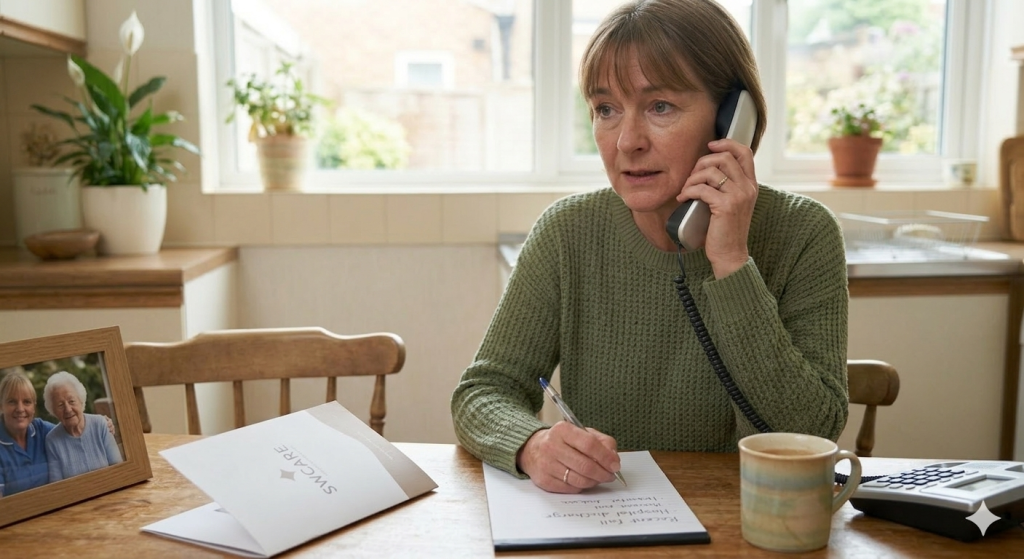
01
One 10-Minute Phone Call Gives You Clarity
Call our care team on 01242 352 554 or send an email. Speak directly to Kasha, Kamila, Stacey or Faisal — our care team. Tell them what’s worrying you and what you need. No pressure. They’ll walk you through the process.
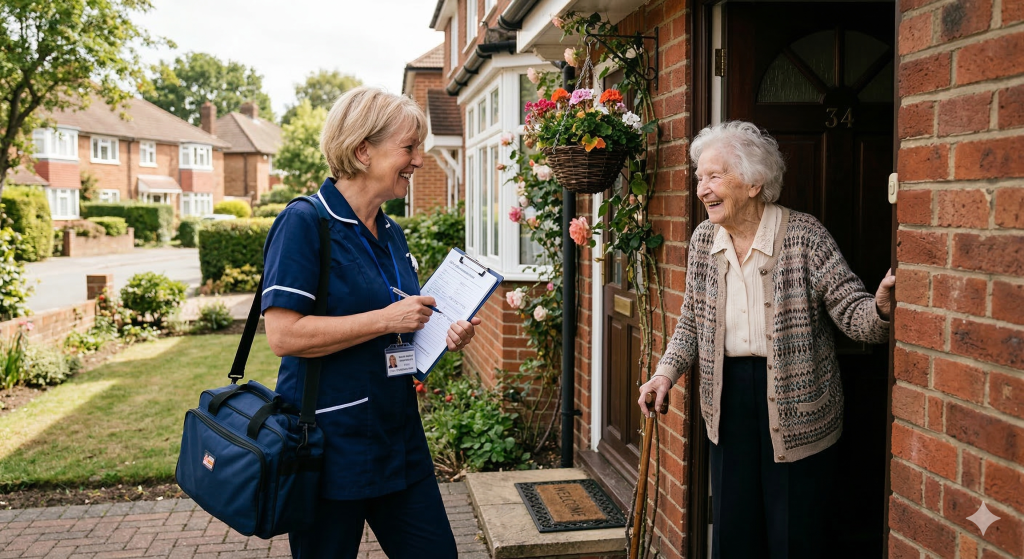
02
We Visit. We Listen. We Assess and Plan.
We visit you and carry out a CARE ASSESSMENT. It’s FREE and will give you a detailed plan of what care is required. Plans are made to fit your budget and personal family circumstances.
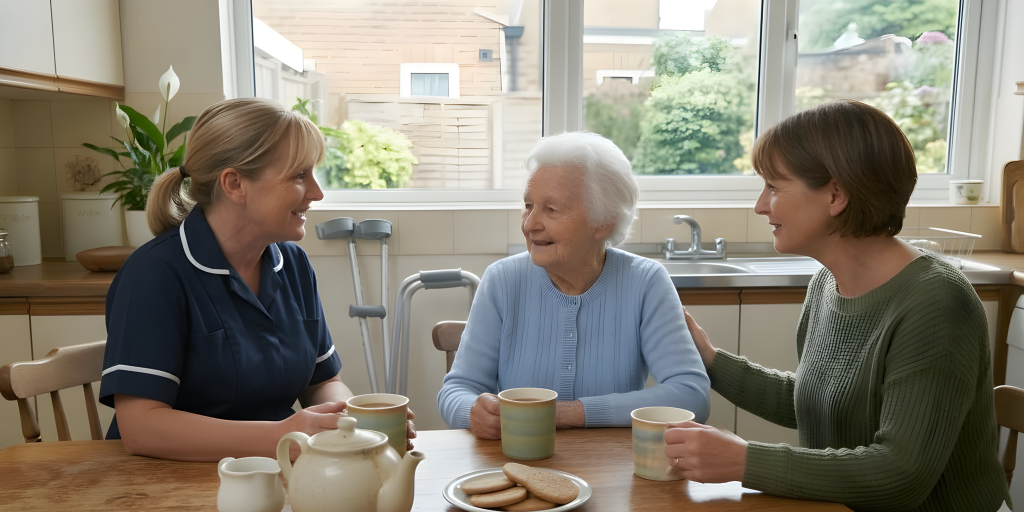
03
Your Parent Gets Their Own Small Team
Based on your loved one’s needs, we match a SMALL TEAM of qualified and appropriately trained carers. And if and when you are happy with everything, we will begin care.
The best way to start is to call our dedicated Cheltenham care team on 01242 352 554 or send an email. There’s no obligation. They’re here to answer your questions and help you decide at your pace.
Get Expert Guidance on the Right Care for Your Loved One
In just 10 minutes, our care coordinators will help you understand your options and create a plan that works for your family.
There is never any obligation.
Get Clarity in 10 Minutes.Peace of Mind for Your Loved One.
Speak directly to our care team—Stacey, Kasha, Kamila, or Faisal—at our Cheltenham office. You’ll get clear answers about what care looks like, what it costs, and whether it’s the right step for your loved one.